
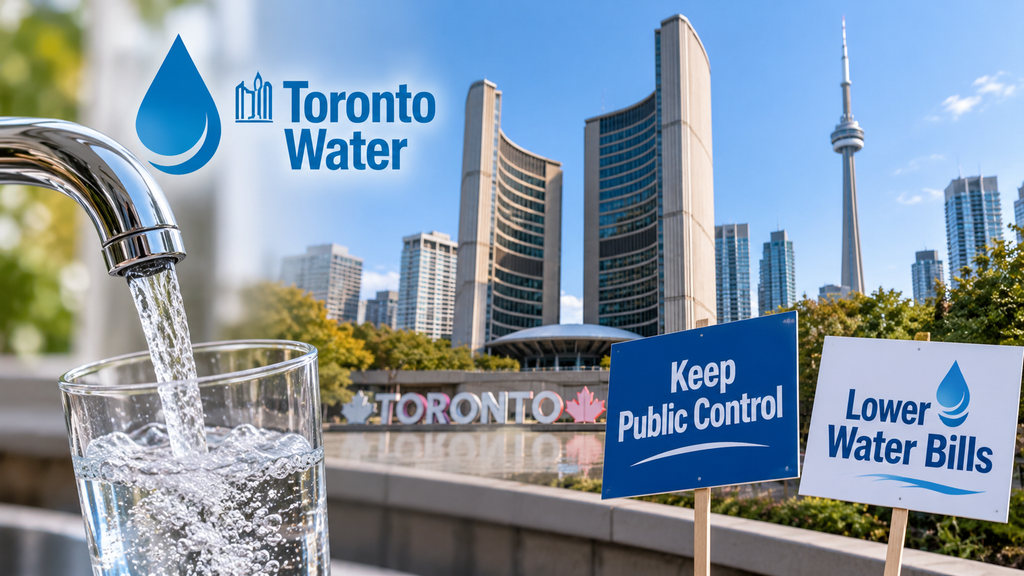
TORONTO, October 22, 2026 – Toronto Mayor Olivia Chow said on October 21 that she opposes mayoral candidate Brad Bradford’s proposed reforms to Toronto Water, warning that restructuring the city’s water system into an independent municipally owned utility could weaken direct municipal control over water rates, infrastructure investment and water services, while increasing the risk of future privatization.
Chow held a campaign event near the R.C. Harris Water Treatment Plant that day, where environmental scientist and broadcaster David Suzuki appeared in support of her campaign.
She said drinking water is an essential public service that residents depend on every day and that its current management structure should not be changed simply to reduce water bills in the short term. Chow argued that weakening municipal control over the water system could limit the city’s ability to set water rates and make decisions about upgrading water pipes and other infrastructure.
The dispute stems from Bradford’s earlier proposal to restructure Toronto Water. He has pledged that, if elected, he would turn Toronto Water into an independent municipally owned utility similar to Toronto Hydro and reduce residential water bills by 25 per cent, saving the average household approximately $300 annually.
Bradford has said the new corporation would remain 100 per cent owned by the City of Toronto, with private investment prohibited through a municipal bylaw. His proposal would use borrowing to finance long-term water infrastructure rather than relying primarily on current water rates to build up capital reserves in advance. Bradford’s campaign has rejected claims that the plan amounts to privatization, maintaining that the city would retain full ownership.
However, a legal analysis commissioned by CUPE Local 416, which represents some Toronto water workers, and prepared by Goldblatt Partners raised concerns about the proposal.
According to the analysis, Ontario’s existing Water and Wastewater Public Corporations Act gives the provincial government broad regulatory powers over matters such as ownership, board composition, financing arrangements and rates if a municipality establishes a new water utility corporation.
The legal opinion argues that even if Toronto City Council passes a bylaw prohibiting private investment, it cannot fully prevent the provincial government from changing the relevant rules in the future or intervening in the corporation’s governance. As a result, the analysis identifies a potential risk of reduced municipal control.
The report also notes that Bradford’s publicly released proposal has not yet provided specific figures on the scale of borrowing, financing costs or long-term financial implications.
It is important to note that the legal analysis was commissioned by CUPE Local 416 and has become a key argument among those opposing Bradford’s proposal. It is not an official legal determination issued by the City of Toronto.
CUPE Local 416 also said that 16 current members of Toronto City Council, including Chow, support keeping decisions about Toronto Water rates, infrastructure investment and management under direct City Council control.
The union expressed concern that managing water services through an independent corporation could reduce residents’ opportunities to hold water utility decision-makers accountable through their elected councillors.
Bradford’s campaign, meanwhile, maintains that the proposed corporation would operate under a structure similar to Toronto Hydro and remain publicly owned. His campaign argues that changing how infrastructure projects are financed could reduce the portion of current water bills allocated to capital reserves, resulting in lower household costs.
Chow also connected the water utility debate to broader cost-of-living concerns during her campaign event. She said that rather than changing Toronto Water’s ownership and management structure, the city should focus on helping residents reduce everyday expenses through policies addressing public transit, food and housing.
As Toronto’s October 26 municipal election enters its final stage, the proposed Toronto Water restructuring has become a significant policy disagreement between the two leading mayoral candidates.
The debate centres not only on whether water bills can be reduced, but also on how major water infrastructure projects should be financed in the future and how decision-making authority should be divided among the municipal government, the provincial government and an independent public utility.
(LJI by Yuanyuan)